Do You Know what Your FEA Simulations Tell You?
Fatigue and failure in polymers and composites is different from that in metals or ceramics. The crucial difference is that failure and fatigue are RATE-DEPENDENT. Often, a polymer yields when the strain rate is low and fractures when it is high (even at the same temperature and pressure). Often, a polymer yields under compression yet fractures under tension (even at the same temperature, pressure, and strain rate). Often, a polymer can yield locally far away from the fillers yet fracture near the filler surfaces — or it could be the opposite (the competition between adhesive and cohesive failure).
Today, we use Fracture Mechanics to predict the stress at which a material cracks (and to do that, we need to assume that some cracks are already there). Separately, we use the Eyring Theory of Plasticity to predict the stress at which the material yields (and it is rate-dependent, so this is good). What we often do not know is when to use one vs. another. Also, the Fracture Mechanics models (Griffith, Lake-Thomas, and others) are typically static or equilibrium and do not account for the rate-dependence. Also, the models generally do not account for polymer properties being different near the filler or air surfaces.
There is a very simple physics that determines whether the material yields or fractures (the so-called Brittle-Ductile Transition). It goes like this. Once the material is pulled out of the initial elastic regime, it must flow. Such uniform plastic flow can only be sustained if the strain rate is smaller than the effective relaxation time. If it is larger, plastic flow is impossible and the material fractures. This is it — everything else are details.
Our ongoing research aims to describe these details in the following way:
- Compute the material relaxation times in the bulk (TS2 theory).
- Compute the changes in the relaxation time near the filler surfaces.
- Estimate the Brittle-Ductile Transition (BDT). (It can be presented as transition temperature for a given strain rate, or, alternatively, transition strain rate for a given temperature).
- Calculate the stress-strain curve that terminates in yield (below BDT) or fracture (above BDT).
- Understand how the relaxation times are changed due to aging and proximity to the fillers, and then repeat steps 1-4 in different locations of the sample.
All the above can be written as user routine for any FEA package and used to incorporate failure analysis inside any visco-elasto-plastic (or even viscoelastic) FEA model.
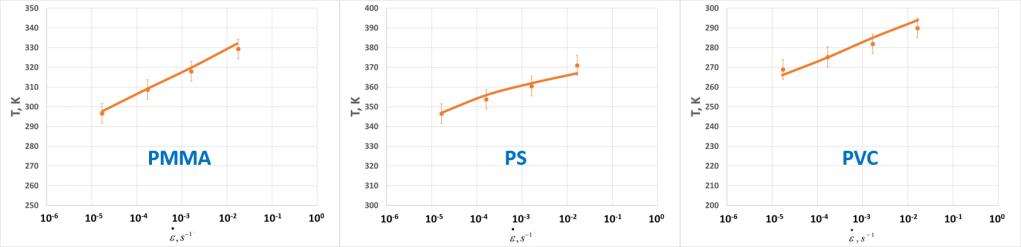
The figure below shows our modeling of the BDT for three important amorphous polymers, poly(methylmethacrylate), polystyrene, and poly(vinylchloride). For details, see our recent preprint, https://arxiv.org/abs/2605.04753.
We are also working on the development of fatigue model. Again, the story is somewhat similar — the number of cycles to failure (N) depends on the applied stress amplitude (S) via the Basquin’s Law (at least in the high-cycle limit), N = AS^m. The prefactor A depends on the temperature, pressure, aging, and material relaxation times, while the power-law factor m is a number between 3 and 12. We are working on predicting A and m based on the polymer properties and the sample history. Ideally, we should be able to understand not just when the failure occurs but also where it happens first.

