My current research at Michigan State University is devoted to theory of glassy polymers. Below I describe its fundamentals and potential applications.
Fundamentals Overview.
We use a theory called TS2 (“two states, two (time)scales”) to describe the main feature of the glass transition, i.e., the dramatic increase of characteristic times as the temperature is approaching the glass transition temperature, Tg, from above. In many textbooks this process is described using the concept of “free volume” — as the free volume disappears, all movement becomes hindered and eventually becomes completely frozen. This is the famous VFT (Vogel-Fulcher-Tammann) picture. We use, instead, a two-state model, with the low-temperature state (“Solid”) having larger activation energy, larger density, larger cohesive energy density, and smaller entropy; the higher-temperature state (“Liquid”) has smaller activation energy, smaller density, smaller cohesive energy density, and larger entropy. Upon cooling from the melt, near T = Tg, the fraction of the “solid” elements increases rapidly, so that the dynamics slow down in a strongly non-Arrhenius fashion. At temperatures below Tg, a significant portion of the material is now “solid” (“glassy”), corresponding to large activation energy and thus, extremely long relaxation times. However, neither activation energy nor relaxation time diverge at any finite temperature.

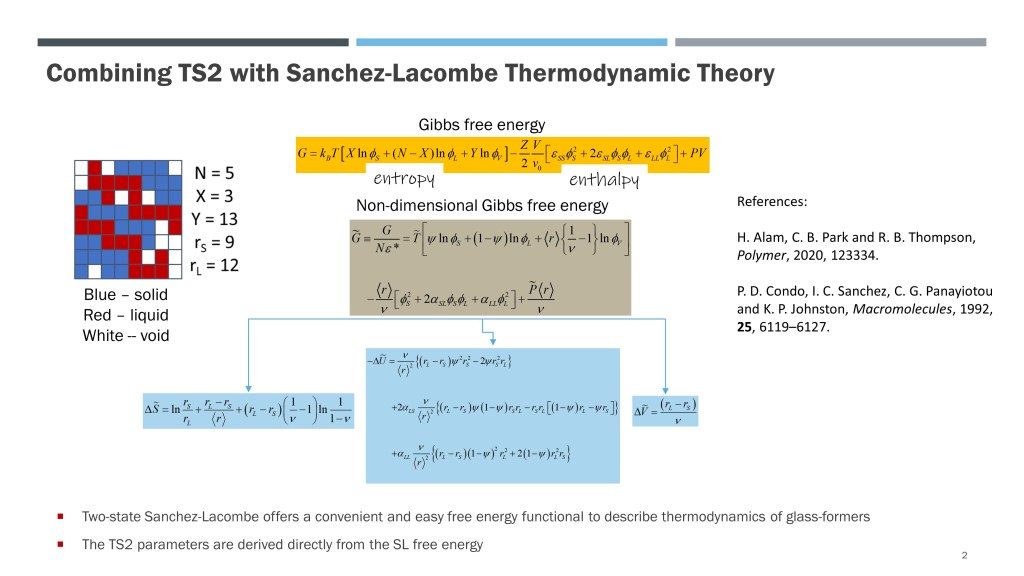
TS2 approach can be combined with thermodynamics equations (such as Sanchez-Lacombe) to combine the relaxation measurements (such as alpha and beta relaxation times in dielectric spectroscopy) with pressure-volume-temperature (PVT) data.
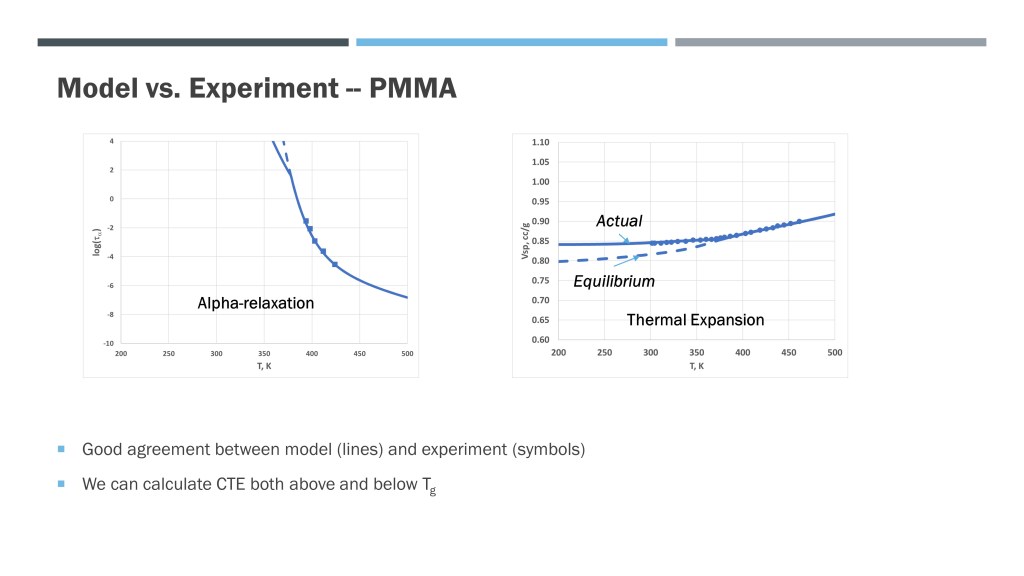
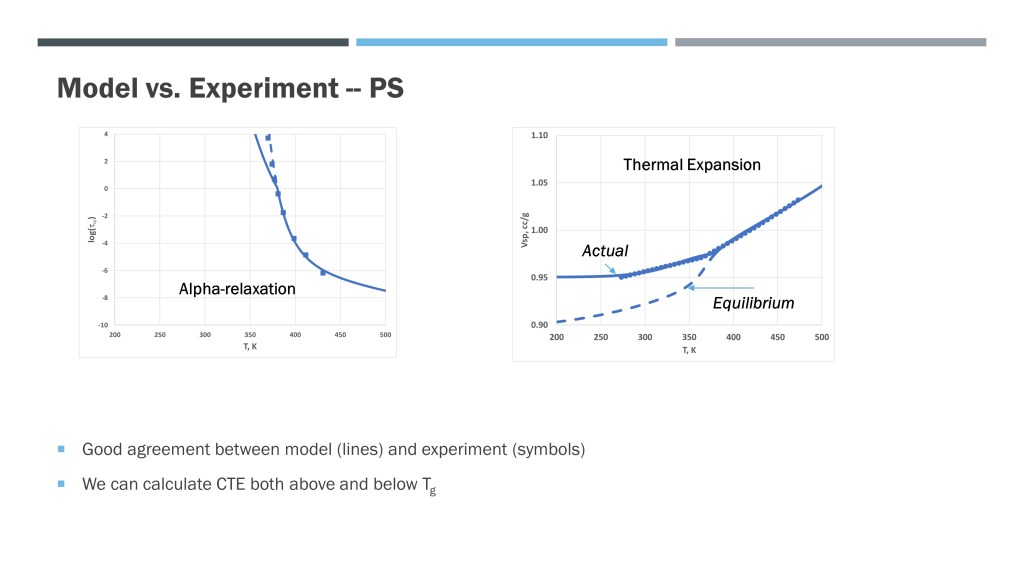
As a result, we can describe thermal expansion and dielectric relaxation of amorphous polymers such as PS and PMMA, as shown below. The curve labeled “Actual” corresponds to theoretical calculation where the “void fraction” is quenched (not annealed) once the temperature drops below Tg.
Next Steps and Applications
- Mechanical Properties of Glassy Polymers — Predicting Yield Stress and Fracture
- Thermodynamics, Mechanics, and Rheology of Free-Standing and Supported Thin Films
- Mechanics of Nanocomposites — the Impact of the “Interphase”
- Optimization of Polymer Processing (e.g., Mechanical Recycling) for Improved Properties
References
- Ginzburg, V. V. (2020). A simple mean-field model of glassy dynamics and glass transition. Soft matter, 16(3), 810-825, https://doi.org/10.1039/C9SM01575B
- Ginzburg, V. V. (2021). Modeling the Glass Transition and Glassy Dynamics of Random Copolymers Using the TS2 Mean-Field Approach. Macromolecules, 54(6), 2774-2782, https://doi.org/10.1021/acs.macromol.1c00024
- Ginzburg, V. V. (2021). Combined description of polymer PVT and relaxation data using a dynamic “SL-TS2” mean-field lattice model. Soft Matter, 17(40), 9094-9106, https://doi.org/10.1039/D1SM00953B
- Ginzburg, V. V. (2022). Modeling the Glass Transition of Free-Standing Polymer Thin Films Using the “SL-TS2” Mean-Field Approach. Macromolecules, https://doi.org/10.1021/acs.macromol.1c02370
 VVG Physics Consulting